
Editorial
When a Creator Becomes Your Industry's Analyst
A creator becomes an industry analyst when others adopt their tests and questions. The Humane AI Pin case shows what brands should notice and answer.

Key points
- A creator's reach tells you how far an opinion can travel. Their analytical influence becomes visible when other people adopt the questions, comparisons, or tests behind it. That change calls for evidence and a response to the substance—not merely another name on an influencer list.
September 25, 2026 editorial edition; first added to the site October 19, 2026. The opening and secondary illustrations are AI-generated conceptual scenes.
In the timestamped transcript of Marques Brownlee's Humane AI Pin review, the discussion around nineteen minutes turns from product faults to the reason for the product.
The AI Pin was a screenless, clip-on computer, operated through speech and an interface projected onto the palm. It offered a different way to interact with computing; the smartphone comparison was unavoidable.
A useful assistant needs context about its owner. Much of that context already lives on a smartphone. Brownlee asks why the new device does not connect to it.
That question cannot be answered by making the battery last a little longer. It challenges the choice around which the product has been organized.
This is the point at which a creator can function as an industry analyst. They establish a comparison, explain why it matters, and give other people a way to judge the product. The camera is the distribution method. The test is the influence.
I would watch the test much more closely than the follower count. Once it travels into other people's reasoning, the company has to answer a question it did not put in its launch deck.
The review was more discriminating than its headline
Brownlee's April 14, 2024 video arrived with a title designed to be remembered:
“The Worst Product I've Ever Reviewed... For Now”
The transcript records a more discriminating assessment than the headline: appreciation for the hardware construction and battery attachment, and a later account of capturing an idea while driving. The criticism sits alongside an account of what the product is trying to achieve.
The consequential comparison comes around 18:36–20:20. The phone already holds information and conversations that a separate assistant lacks. Independence, presented as a route to a new kind of computing, creates friction in the experience available now. That is the argument recorded in the transcript.
This is much more useful to a product team than the word “worst.” It identifies the thing the customer will compare the product with, and the practical advantage the new device must overcome. An ambitious future does not remove an existing alternative from the buyer's pocket.
Julian Chokkattu's April 11 WIRED review had already reported slow or inaccurate responses, limited functionality, and difficulties with the projected interface. It preceded Brownlee by three days.
That chronology matters. The convenient story is that one powerful creator delivered a verdict and the world obeyed. The available record shows a product facing independent criticism, followed by a high-profile review that made a broader comparison easy to grasp and reuse.
A communications team needs to distinguish those two situations. If a claim comes from a single faulty test, correcting the conditions may change the story. If several reviewers encounter related problems, the review is part of a product issue that publicity alone cannot resolve.
Key insight
There is another distinction inside the criticism. “This task failed” asks engineering to investigate. “Why would I use this instead of my phone?” asks product strategy to justify the extra device. Both can appear in the same review. Sending both to the influencer-relations team is an efficient way to answer neither.
When the creator's question becomes someone else's argument
The reuse was visible within days.
On April 15, software developer Benjamin Sandofsky embedded Brownlee's video in his own essay about Humane. He used the product's reception as an entry into an argument about startup development and the risks of trying to build like Apple. The review was becoming material in an industry practitioner's explanation, alongside other sources and his own theories.
On April 18, Jason Aten's Inc. column explicitly discussed Brownlee's review and challenged the underlying premise of replacing the smartphone. Aten argued that an assistant working with the phone would pose a different proposition from one trying to separate itself from it.

Aten returned to the premise in his own podcast discussion that day, describing his disagreement with the assumption that people wanted an assistant separate from their smartphones. This was no longer merely a striking title being passed around. It was a basis for discussing what should have been built.
These are observable handoffs that a monitoring team could have recorded that week: who picked up the review, which part they used, and what new question they asked with it.
That is an earlier and more useful finding than waiting to declare that the brand has a reputation problem. By April 18, a response focused only on fixing individual faults would already have left a documented objection to the proposition unanswered.
The comparison changes what a good answer looks like
Suppose a company answers that the next release will be faster, more accurate, and more reliable. Those improvements matter. But a buyer using the smartphone comparison can accept every improvement and still ask why a separate device belongs in their life.
The comparison has changed the burden of proof. The company now needs to show a task, a person, and a setting in which the additional device is worth its additional friction. A roadmap full of features answers a narrower question.
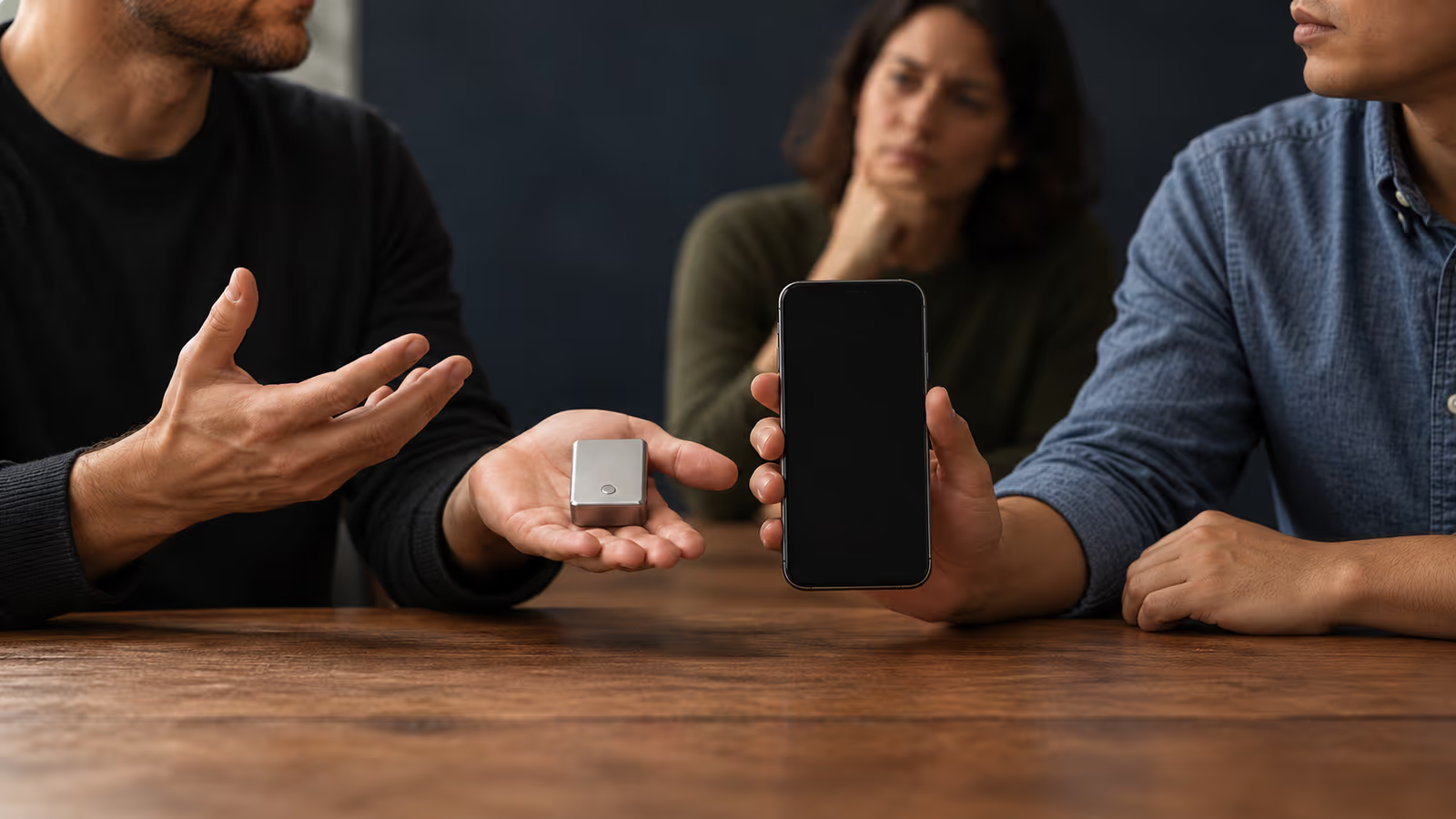
I think this is the part of creator influence that a reach ranking misses. A creator can make the buyer's existing habit newly visible as a competitor. They can introduce a standard the category has avoided, or make an old objection understandable enough to travel.
The useful frame change is then visible in the question. A discussion about technical novelty becomes a discussion about useful difference. A discussion about whether a feature works becomes a discussion about whether the whole proposition is worth choosing.
A product can pass its own demonstration and fail the comparison the audience has adopted. That is a strategy problem with a communications consequence.
An analyst role is earned through the work
Analytical authority needs a record of work other people can inspect. A large audience can distribute a weak argument just as efficiently as a strong one.
The original claim needs to remain attached to its conditions: the product version, the task attempted, the alternatives considered, and the places where the reviewer is speculating. A later writer may preserve those details, sharpen the argument, or strip them away. Each is a different kind of influence.
This is why I would follow a claim through its handoffs instead of collecting mentions of the creator's name. Does a journalist cite a demonstrated failure? Does a customer use the comparison to explain a decision? Does another reviewer reproduce the task and get a different result? The last of those can be the most useful thing in the conversation.
An imitation template can spread a joke. A shared test lets people compare evidence. A video can do both; the report should preserve the difference.
Key insight
The later financial history should not be forced into a morality tale about the review. In February 2025, HP agreed to acquire key Humane AI capabilities for $116 million, including technology, talent, and intellectual property. That is a separate business outcome. It does not tell us how much any reviewer contributed to it.
The response belongs with whoever can answer the question
There is a familiar administrative temptation here: decide whether the person belongs on the press list, the influencer list, or the analyst list, then let that classification choose the response. The spreadsheet can survive an identity crisis. The product claim needs an answer.
Brownlee's comparison needed people who understood the product's architecture and intended use. The independent functional findings needed people who could reproduce and investigate them. Aten's objection needed a clear account of the customer problem the device was meant to solve. Access to a launch event would have answered none of those questions.
“If Humane had simply built an AI-powered assistant that worked with a smartphone, I think this might be an entirely different conversation.”
For another brand, the adopted test could be favorable. A reviewer might show that a modestly priced camera does unusually well at a task its buyers care about. The opportunity would be to establish where the advantage holds and make that use clear. Positive interpretation needs the same attention to evidence as criticism.
This extends source escalation beyond a ladder of publications. The person with authority over a particular decision may publish a video, a newsletter, or a specialist forum post. A national headline can arrive later without adding much to that decision.
The question I would put in the next report is: whose way of judging this category is being adopted, and what does it now require the product to prove?
That is a more consequential development than another influential person having an opinion. Someone has supplied the test. Other people are beginning to use it.
Related
glossary ·
Source Escalation in Reputation Monitoring
Source escalation is a story climbing the media ladder — from trade press to mainstream to political engagement. The direction matters more than the volume.
glossary ·
Imitation Template: Definition for PR Teams
An imitation template is content so simple that strangers reproduce it carrying the same critique. A viral video is shared. A template is reproduced.
editorial ·
5 Early Signals Before a Story Breaks
Stories don't break out of nowhere. Five precursor patterns are visible 72 hours before the headline — and the dashboard is built to miss all of them.
editorial ·
When Brand Backlash and Sales Tell Different Stories
American Eagle and Cracker Barrel show why brand backlash needs a commercial interpretation: whose behavior changed, over what period, and at what cost?