Co5
Brand intelligence

Communications requires an understanding of meaning. The tools of yesterday could only deliver an understanding of volume.

In the last quarter century, media monitoring tools have come in two waves. Wave 1 was gathering media. Wave 2 extended that to social listening. Both enabled wider aggregation — but not reasoning.

Brand intelligence is the third wave — the wave of reasoning. It reads the shape of the story — the pattern in how coverage is unfolding, not just the volume of it — and shows you the move that fits. You make the call. That's the category.

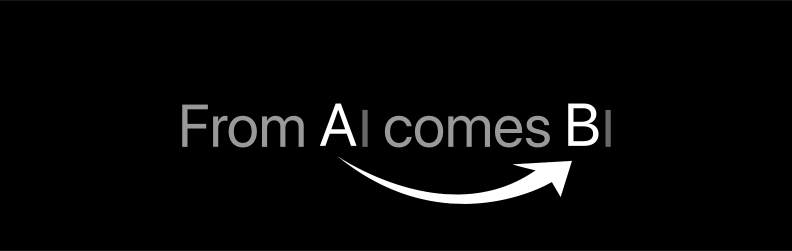
This is the architecture AI now allows. From AI comes BI.

02 · The stakes

Where reputations are made or lost.

Every morning, an operator somewhere has to read where a brand they're responsible for stands — what's being said, what's moving, what's about to. That read is the input to a real decision: respond, stay silent, escalate, reposition, hold. The decision lands on real reputations, real careers, real M&A windows, real share prices.

Boeing 737 MAX · 2019

The trade press to front page shift.

Coverage climbed from trade press to the Wall Street Journal’s front page over weeks. Volume-and-sentiment dashboards showed the spikes. They flattened the critical difference: a trade-press article reaches engineers; a WSJ front page reaches Congress. The shape of escalation was the leading indicator. Teams reading the shape had time to prepare. Teams reading volume alone got blindsided.

Read the Boeing case study


Bud Light · April 2023

The shape moved days before the volume.

By the time the financial impact was measurable, the window to shape the outcome had already closed. The boycott had already spread — not because of any new argument, but because people were copying each other across social. The volume dashboards saw the volume. They missed the pattern of imitation, which was the part actually moving.

Read the Bud Light case study
Trader Joe’s · Ongoing

Tuesday or five-alarm fire.

A constant low-grade hum of customer complaints — a hum that has been there for years, normal for this brand. Most days it’s noise. Twice a year it turns into something. Telling the two apart requires knowing what’s normal for THIS brand specifically, not what’s normal for the grocery industry. Tools that don’t know the difference page operators on Tuesdays.

Why baseline deviation matters

The job isn't to count noise. It's to read meaning before the decision lands.

03The cognitive chain

The work has always had the same five steps.

Every read of where a brand stands in the public conversation — whether it's done by a junior agency analyst at 7 a.m. or by the head of corporate communications before a board meeting — follows the same five steps. The field's research has named each of them for decades.

01
Collection
What is being said about us?
02
Relevance
Which of it matters?
03
Meaning
What does each piece say?
04
Shape
What pattern is forming?
05
Decision
What do we do?

The work, as humans have always done it.

For a quarter-century, the technology could help with the first step and a half of this chain — gathering what was being said, and matching keywords to surface the mentions that named your brand.

The hard part sat in a human's head.

Figuring out what each piece meant. What pattern was forming. What to do about it. Every day. For every brand.

That's where the work always was.

That's where the cost of being wrong always was.

And until recently, that's where the tools couldn't go.

Knowing the words is not the same as understanding them.

04Three waves

Three waves of new inputs. Only one moved the chain.

For twenty-five years, communications technology got better at one thing: collecting more of what was being said about a brand. Wave 1 collected media. Wave 2 added social. Both did a sliver of relevance work on top — matching keywords to surface the right mentions — and that was the extent of it. Everything else stayed in the human chain. Until Wave 3.

01
Wave 01 · 2001 · Internet media monitoring

It collected media. The rest stayed in humans.

Web scraping, RSS, and wire feeds made it possible to gather, at scale, what was being published about a name. Meltwater (founded 2001) defined the category. The work the tool actually did was Collection — pulling articles together — plus a thin slice of Relevance via keyword matching to surface the ones that mentioned the brand. Everything past that — figuring out what each piece meant, holding the unfolding pattern in your head, recommending the call to leadership — sat entirely in the human chain.

01
Collection
What is being said about us?
02
Relevance
Which of it matters?
03
Meaning
What does each piece say?
04
Shape
What pattern is forming?
05
Decision
What do we do?
02
Wave 02 · 2007 · Social listening

It added social to the collection. The chain didn’t move.

Brandwatch (2007) and Talkwalker (2009) extended the collection layer to include social platforms. Same keyword-match relevance underneath. They added a positive-or-negative tag to each mention via classifier models — useful as a column on a dashboard, but not real meaning. The rest of the chain — what each piece actually said in context, what pattern was forming, what to do — still lived in the human strategist. The category got more inputs and a sentiment column. The chain didn’t move.

01
Collection
What is being said about us?
02
Relevance
Which of it matters?
03
Meaning
What does each piece say?
04
Shape
What pattern is forming?
05
Decision
What do we do?
03
Wave 03 · 2026 · Brand intelligence

The chain finally moved. The human keeps the decision.

Large language models can finally understand language the way a person does — reading meaning, not just counting keywords. They can hold eighteen months of context about a single brand in their head all at once, when answering today's question. They can be set against each other — different models from different labs, trained differently — and where they disagree, the disagreement itself becomes a useful signal. The frameworks the field has used to make sense of coverage for fifty years can finally be applied automatically, at scale, calibrated to what's normal for this brand. Relevance, meaning, and shape now have a real partner. The human keeps the one step where their judgment compounds: the decision.

01
Collection
What is being said about us?
02
Relevance
Which of it matters?
03
Meaning
What does each piece say?
04
Shape
What pattern is forming?
05
Decision
What do we do?
The thesis

Brand intelligence isn't AI bolted onto the prior waves. It's the wave built on AI.

05The research

What the field has known since 1972.

None of the frameworks brand intelligence applies are new. They've been the foundation of communications research for decades — taught in graduate seminars, cited in court documents, used by senior strategists every day. What's new is that they can be applied at scale, automatically, in time for the morning decision.

  1. 1972
    Aggregate dissent away, and good decisions die with it.
    Janis· Groupthink
  2. 1974
    How a story is described shapes how people react to it.
    Goffman· Frame Analysis
  3. 1993
    Small framing signals stack into durable narratives.
    Entman· Framing accumulation
  4. 1995
    Recovery from reputational damage isn’t improvised. It’s patterned.
    Benoit· Image Repair Theory
  5. 2007
    Crisis severity comes in tiers; each tier needs a different response.
    Coombs· Situational Crisis Communication Theory

The discipline has always been about reading meaning. The tools could only count. Now they can comprehend.

The doctrine
Crisis managers must match the response strategy to the crisis type. Get the type wrong and the response itself becomes the next crisis.
W. Timothy Coombs · Situational Crisis Communication Theory · 2007
06Four moves

What that means in practice.

Brand intelligence is not a feature of the prior waves with a better UI. It is a different architecture making four moves the prior waves cannot make. Each move is grounded in technology only recently tractable.

01
Move 01

Reads the shape, not just the volume.

Stories tend to fall into recognizable patterns. A product-safety problem unfolds differently from a CEO scandal, which unfolds differently from a culture-war flare-up, which unfolds differently from a low-grade complaint baseline that flares twice a year. Each pattern names a different kind of stake and calls for a different kind of response. Volume-and-sentiment can tell you a story is loud and negative. Shape-reading tells you which story it is.

How narrative tracking works
02
Move 02

Calibrates against each brand’s own standing.

Tesla’s negative coverage is Tuesday. Michael J. Fox’s negative coverage is a five-alarm fire. Same delta on a sentiment chart, completely different stake in the world. Standing is the answer to one question: what’s normal for this brand, in particular? Updated continuously from outside sources, held separately from any industry average. Tesla normal isn’t Michael J. Fox normal.

The CrowdStrike standing shift
03
Move 03

Cross-challenges between specialist analysts.

Any single model carries its own training biases — blind spots it can’t see around. Five specialist models from five different labs — Anthropic, OpenAI, Google, Meta, DeepSeek — each trained differently and prompted for a different lens, produce different reads of the same coverage. Where they agree, you get confidence. Where they disagree, the disagreement itself is a useful signal. We call it the Council of 5 architecture — more expensive per question, more honest in answer.

Why opinion structure matters
04
Move 04

Recommends the move, grounded in research.

The recommended action isn’t a guess. It’s the response that crisis-communication doctrine, frame-analysis research, and the brand’s own historical patterns predict will hold up. Operators don’t get “you should probably respond.” They get the specific move that fits the shape of the story, with the doctrine that grounds it. Doctrine-grounded for the board, traceable to source, ready for legal.

The Fink crisis model, revisited
07Who this is for

For operators whose question isn't “what was published.”

Brand intelligence isn't the morning monitoring tool. It's for the people whose morning question has shifted — from what was published about us to what does this mean, what does it cost us, and what do we do. Three roles tend to be there.

The CCO

Chief communications officer.

Owns the public-facing posture at a mid-market or enterprise brand. Needs the daily read before the board call, the analyst inquiry, the activist letter — and right now is piecing it together from agency briefs and Slack threads.

The Strategy Director

Agency strategy director.

Manages five to fifty client portfolios across categories and crises. Needs to scale the read without scaling head-count linearly. Trades depth for breadth today, and knows it.

The IR Lead

Investor relations and executive monitoring lead.

At a public company. Needs the read calibrated against company-specific reactivity and historical patterns. Uses media monitoring tools that can’t distinguish Tuesday from crisis — which means the briefing reads the same on both.

How to know you're shopping in the right category

If you're asking…

→ See every honest head-to-head at the Compare hub

And one note: AI brand monitoring

You'll get pitched a “sixth category” — AI brand monitoring tools (Profound, Athena, Goodie, et al.) — that promise to track and “optimize” what LLMs say about your brand. It's not a sixth category. It's SEO consulting wrapped in AI marketing language: LLMs reason from training data (frozen) or pull from search results (which is just SEO). There's no separate lever. Read the full analysis →

Common questions

What buyers ask about brand intelligence.

What is brand intelligence?

expand_more

Brand intelligence is the daily, defensible read on what's happening to a brand — calibrated against that brand's own history, with the shape of the story named and a recommended action attached. It is the artifact a comms leader walks into the boardroom with, distinct from monitoring (volume), social listening (sentiment), and brand measurement (NPS-style surveys).

How is brand intelligence different from media monitoring?

expand_more

Media monitoring counts and surfaces mentions — coverage volume, source breakdown, reach. Brand intelligence reads what that coverage MEANS for this specific brand right now, against the brand's own normal, and names the shape forming. Monitoring is the data layer; brand intelligence is the comprehension layer that sits on top.

How is brand intelligence different from social listening?

expand_more

Social listening scores tone across mentions, charts sentiment over time, and detects volume spikes. Brand intelligence reads frame, source escalation, and arc phase — the structural signals that move days before sentiment does. A negative-sentiment chart and a brand-intelligence read of the same coverage tell two completely different stories.

Why is brand intelligence called the third wave?

expand_more

Wave one (1990s–2000s) was media monitoring — counting coverage. Wave two (2010s) was social listening — measuring sentiment at scale. Both expanded what could be measured but kept the cognitive chain the same: a human reads everything, calibrates against their own gut, and decides. Brand intelligence is wave three — the AI-native discipline that finally automates the comprehension layer the prior waves left to the human.

Why couldn't brand intelligence exist before AI matured?

expand_more

Brand intelligence requires reading shape against the brand's own history, holding context across hundreds of articles, and weighing what something means in light of a century of crisis and reputation research. Counting and sentiment scoring were possible with statistical techniques from the 1990s. Comprehension at scale needed modern AI. From AI comes BI.

What specifically does brand intelligence read that the prior waves cannot?

expand_more

Three structural signals: frame (the implicit question the coverage is answering), source escalation (whether the story is climbing the media ladder from trade press to political engagement), and arc phase (the lifecycle stage — incident, design question, integrity question, systemic failure). All three move before volume or sentiment do.

Who uses brand intelligence?

expand_more

Communications leaders — CCOs, heads of comms, agency directors — who carry responsibility for the read a leadership team makes about a brand. The deliverable is the daily artifact they walk into the boardroom with: today's state of the brand, what's moving, what to do. Less relevant for tactical execution teams who need volume dashboards or social publishing tools.

For twenty-five years, the tools could only count. Now they can comprehend.

What was always in the strategist's head — relevance, meaning, shape — finally has a partner. The call still belongs to her.

That's the third wave. That's brand intelligence.

From AI comes BI. From A to B.