
Guide
A Quiet Monitoring Dashboard Isn't Proof Nothing Happened
A quiet monitoring dashboard can mean no completed read, no new coverage, routine coverage, old reach growth, or a new signal. Here's how to tell which one.

Key points
- A quiet dashboard is useful only when it explains the quiet. It should say whether the read ran, whether the system found relevant coverage, whether it changed the story, and whether old coverage is still moving. This guide shows the five quiet states and the simple brief a user can trust.
At 8:10 on a Monday morning, the dashboard is quiet.
No red alert. No sentiment drop. No front-page story. No volume spike.
You exhale for half a second.
Then the useful question arrives: did the system actually look?
A quiet monitoring dashboard can mean you are safe. It can also mean the system stopped looking. Those two states look almost identical when the interface only says "no new coverage."
That is the whole problem. Quiet is not one thing. It can mean the read never ran. It can mean the read ran and found nothing. It can mean the read found routine coverage that did not change the story. It can mean an old post is gaining reach. Or it can mean the dashboard should not be quiet at all because a new signal arrived.
All five can collapse into the same sentence: "nothing new."
That sentence is too blunt for real work.
Key insight
The point is not to make the dashboard busier. The point is to make quiet defensible. If leadership hears "nothing material changed," the team should be able to answer the next question without scrambling: how do we know?
Why a quiet monitoring dashboard makes teams nervous
Quiet should feel good. Most communications teams would happily take a real quiet day over a false alarm.
The problem is that many dashboards do not prove the quiet. They just display it.
The card is old. The feed has not changed. The badge says no new coverage. Does that mean the story has been quiet for 28 hours, or that nobody looked for 28 hours? Did the system check the right sources? Did YouTube or X fail in the background? Did it find one weak post and decide it did not matter?
Those are not edge cases. They are the daily job.
Serious monitoring has two jobs. First, collect evidence. Second, decide whether a human needs to act.
That is the useful lesson behind the Google SRE book's monitoring chapter: watching a system and waking someone up are not the same thing. Reputation work needs the same split. Reading the environment is one act. Escalating a finding is another.
A system that did not escalate anything still has to prove it looked. It should show that the read ran, which sources returned, what was found, what was judged, and why the system stayed quiet.
Without that record, quiet is not evidence. It is a guess.
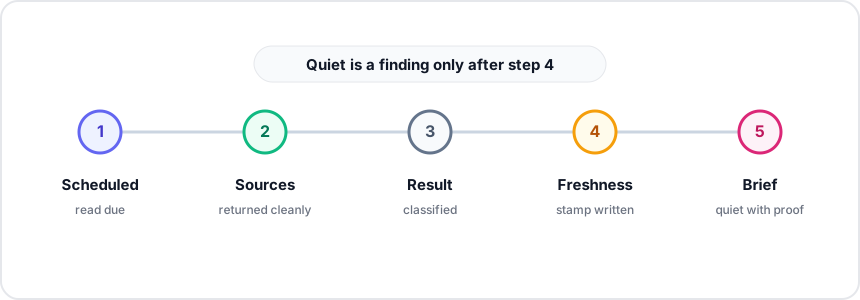
A quiet read needs an evidence trail: scheduled, completed, sources checked, result classified, and briefed with the right label.
How to tell no new coverage from no read
Start with the simplest question: did the read happen?
If the answer is no, the dashboard should not say "no new coverage." It should say "read overdue" or "source check incomplete."
That is not a reputation finding. It is a system problem.
If the answer is yes, the next question is just as plain: did it find anything?
If it found no matching coverage or posts, "no new coverage" is fair. If it found routine items, the label has to change. The better sentence is "coverage found, no material change" or "routine coverage only."
That difference protects trust.
Saying "no new coverage" when the system found a routine forum post or an owned social update is not quite true. It hides the fact that the system did real work: it looked, found something, judged it weak, and stayed calm.
That is a useful finding. It deserves its own label.
The rule is simple: do not use an absence label for a judgment finding.
If nothing was read, say the read is overdue. If sources failed, say checks are incomplete. If nothing matched, say no new coverage. If routine coverage matched but changed nothing, say no material change. If an old item moved, say reach changed on prior coverage. If the story changed, say the signal changed.
This sounds fussy until the CEO asks why yesterday said "nothing new" and today says the same story has been moving for two days.
The honest answer may be simple: yesterday's coverage existed, but it did not change the read. That is defensible.
"The dashboard said nothing" is not.
The five states behind no new coverage
Most dashboards compress too many quiet states into one quiet surface. The practical fix is to separate five states.
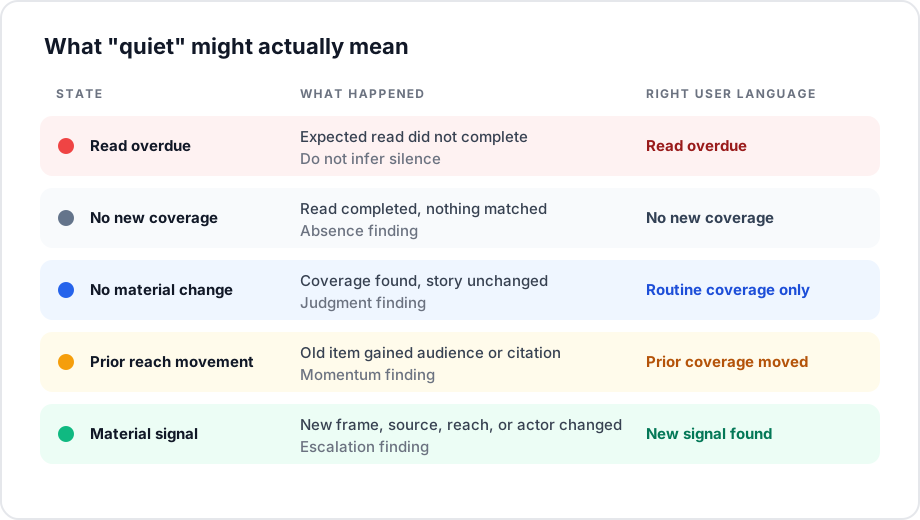
The quiet state is not one thing. Each state tells the team what happened, what it means, and what to do next.
1. Read overdue. The system did not complete the expected read. This is not a reputation assessment. It should show the missed window and the next retry.
2. No new coverage. The read completed and found no matching new coverage or posts. This is the cleanest version of "no new coverage." The useful sentence is: read completed at 7:42 a.m.; no matching coverage found.
3. Coverage found, no material change. The system found coverage, but the coverage did not change the story. A low-reach repost, a routine owned social update, or a forum comment repeating an existing frame is not nothing. It is evidence that the system looked and made a judgment.
4. Prior coverage movement. No new story appeared, but old coverage gained reach, was cited by another source, or started moving again. The article is old. The consequence may be new.
5. New material signal. New coverage, source movement, frame change, action from an important audience, or a reach jump changes what is likely to happen next. Now the question is no longer "did we find coverage?" It is "what kind of signal did the coverage become?"
This is not naming for its own sake. It is plain English for the user. They should be able to see whether the system failed, found nothing, found something routine, found renewed reach, or found a real signal.
Why old stories can still move after today's coverage is quiet
The easiest monitoring mistake is treating an old article as a dead article.
A story can be published on Tuesday, ignored on Wednesday, cited by a trade outlet on Friday, and show up in a regulator's briefing book the next week. The original article is old the whole time. The consequence is not.
This is why "no new coverage" cannot be the only quiet-day check. A system that only looks for newly published coverage can miss what happens after publication: reach growth, reposting, citation, newsletter pickup, journalist reuse, influencer commentary, and action from an important audience.
Some of that movement is noise. Some of it is the moment an old story becomes useful to the wrong audience.
The Boeing 737 MAX record is the familiar example. The important reporting did not become dangerous because the words got louder. It became dangerous because the reporting became useful to regulators, congressional staff, and the Department of Justice. The Seattle Times reporting on FAA delegation and Boeing's safety assessment is the kind of source that can change a story even when the coverage count is small.
That is the wider pattern in media volume versus narrative significance: significance often moves before exposure catches up.
The quiet-day version is simpler. If yesterday's story is still gaining the wrong audience today, the day is not quiet. It is a no-new-publication day with active movement on prior coverage.
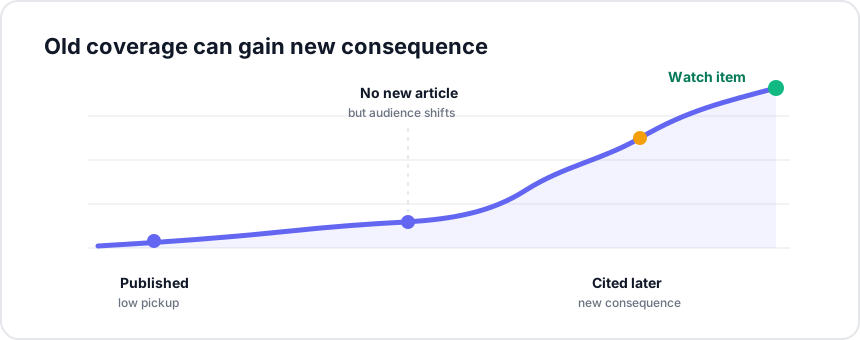
Publication is a timestamp. Consequence is a path. Old coverage can become newly important when reach, citation, or audience use changes.
There is no reason to re-check every old item forever. That would create a new noise problem. But meaningful coverage should carry a short follow-up window. If reach is flat, the checks can back off. If reach grows, the system should keep watching and bring that movement into the next full read.
The point is not to create another firehose.
The point is to stop "old" from meaning "irrelevant."
How to brief leadership when nothing material changed
The quiet-day brief should not say "nothing happened."
It should say what was checked, what was found, and why the story did not change.
Here is the version I would trust:
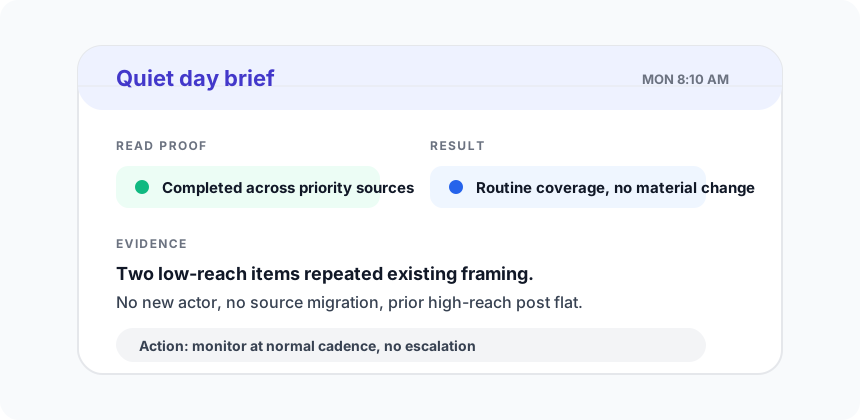
A quiet-day brief should prove the read, name the state, and preserve any watch item without creating false urgency.
Read completed. The system looked at a known time. If a high-priority source failed, say so.
Result state. No new coverage, no material change, prior reach movement, or new signal. One of those. Not a vague quiet label.
Evidence. If coverage was found, explain why it did not change the read: recycled frame, low-reach source, owned channel only, no new actor, no source movement, no important audience changed.
Watch item. If old coverage is gaining reach or a low-volume story sits in a sensitive source, keep it visible without escalating it.
Action. Monitor, watch, prepare, or escalate. The action should match the state.
This is where quiet-day reporting intersects with false alarms versus true escalation. A good stand-down is not passive. It is a decision with evidence behind it.
The sentence I want is simple:
Read completed at 7:42. We found two routine items. Neither introduced a new frame, a more serious source, or meaningful reach. One prior post is still on watch. No escalation recommended.
That sentence is much more useful than "nothing new."
It tells the room the system looked. It tells the room what it found. It tells the room why the team stayed calm.
The Monday test before trusting no change
Monday is the right test because weekends expose lazy monitoring language. Source schedules are uneven. Social posts recirculate. Publishers syndicate old stories. Internal teams are less likely to notice a missed read until the week starts.
Before trusting "no change" on a Monday, ask five questions.
-
Did the read complete? If not, this is not quiet. It is overdue.
-
Did the important sources return? A quiet read with a broken source is only partly observed.
-
Was there no coverage, or no material change? Absence and judgment are not the same thing.
-
Did old coverage move? Publication date is not enough. Check whether the audience changed.
-
Can I defend the quiet sentence tomorrow? If the story breaks later, can I show that today's quiet was based on a completed read and a reasonable call?
The quiet-day test
That last question is the one that matters. It forces the team to treat quiet as a finding, not a blank space.
It also protects credibility. Leadership does not need a false alarm every morning. It needs confidence that "nothing material changed" means someone actually looked.
The honest bottom line
No new coverage is not no signal.
Sometimes it means the system never looked. Sometimes it means the system looked and found no new coverage. Sometimes it means it found coverage that did not change the story. Sometimes it means the old story is still moving. Sometimes it means a material signal arrived and the dashboard should not be quiet at all.
The job is to tell those states apart before the user has to ask.
That is what a serious monitoring discipline owes its reader: not constant urgency, and not comforting silence. Evidence. A clear label. A plain-language reason for the posture.
The sentence should not be "nothing happened."
The sentence should be: "we looked, here is what we found, here is why it does not change the story."
Related
pillar guide ·
False Alarms vs True Escalation: A PR Guide
False alarms don't just waste time — they burn your credibility with leadership. Here's a five-check framework to separate noise from real escalation.
pillar guide ·
Why Media Volume and Narrative Significance Are Not the Same
The loudest story is not always the most dangerous. Volume measures exposure. Significance measures meaning. Teams that conflate the two get burned.
pillar guide ·
From Weak Signal to Material Signal in PR
A signal becomes dangerous not when it gets louder but when it changes who is paying attention. Here's a practical framework for tracking that shift.
editorial ·
5 Early Signals Before a Story Breaks
Stories don't break out of nowhere. Five precursor patterns are visible 72 hours before the headline — and the dashboard is built to miss all of them.
editorial ·
What Brand Monitoring Measures — And What It Doesn't
Sentiment expressed × reach is not sentiment adopted by the audience. Every brand monitoring tool measures the left side of that identity and sells it as if it were the right. This piece names the confusion, walks the sixty years of research that separates the two, and shows what reading adoption would actually take.